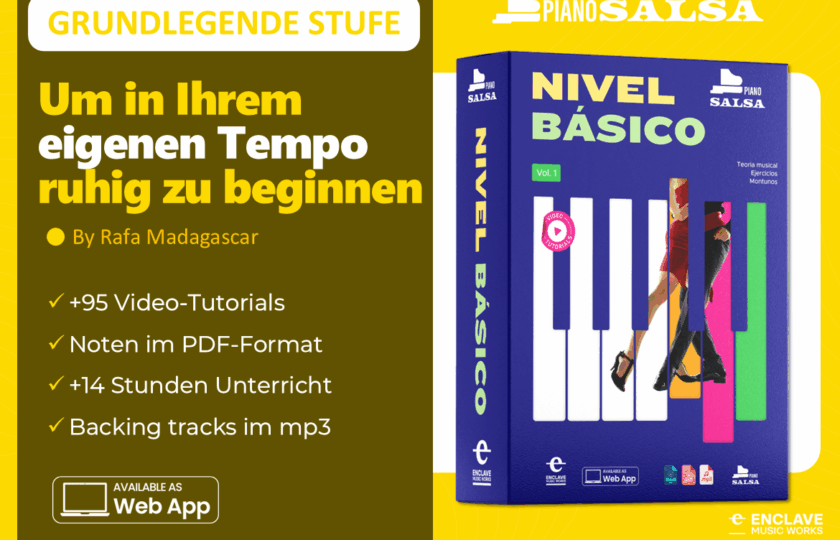
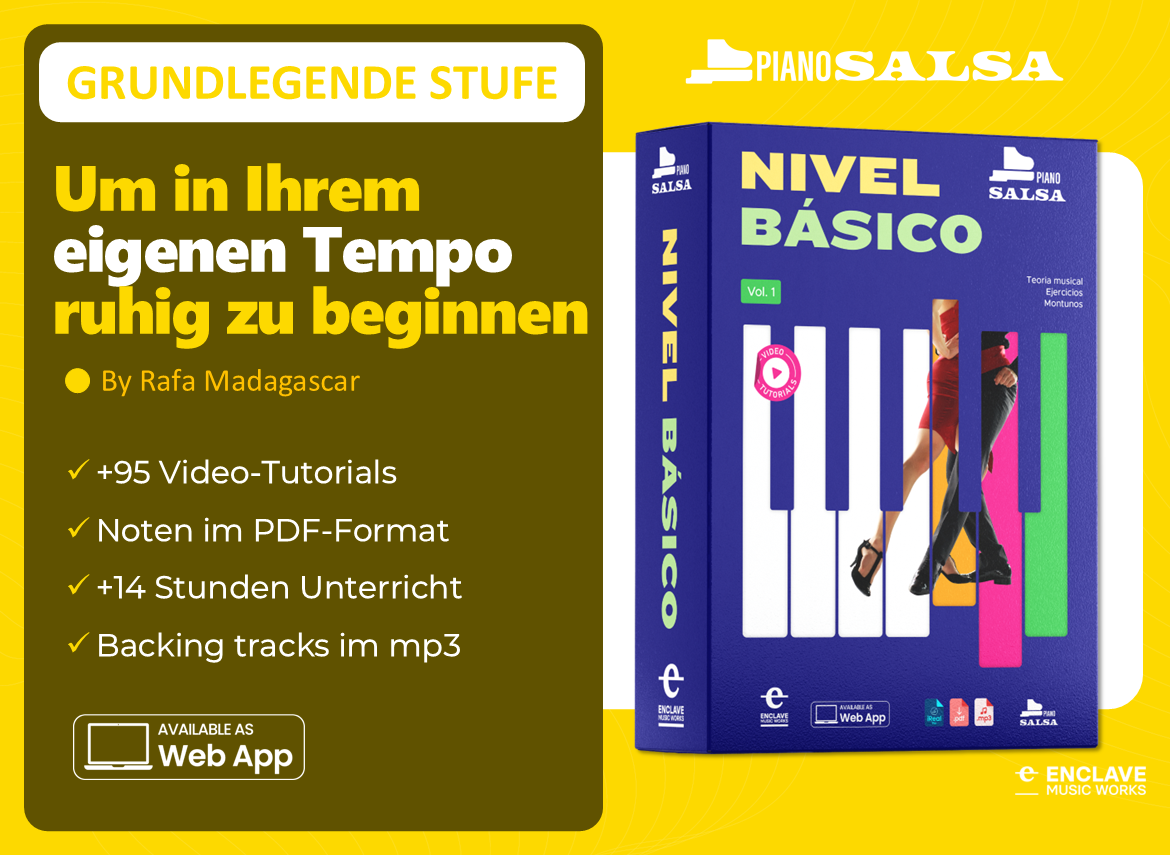
Der Kurs ANFÄNGER STUFE is the first in the series of the 3-step trilogy of the PIANO SALSA Method. This course, as well as the other sections, is divided into 4 large sections: THEORIE, PRAXIS, MONTUNOS and REPERTOIRE. In each of these pages, you will find exclusive material for reading and listening. Fast all videos will be provided with a comprehensive PDF-Datei, in which you will find scores or accompaniments of the content of the individual sections.
Sobald Sie den Kurs gekauft haben, können Sie mit Ihrem Benutzernamen und Passwort im Internet darauf zugreifen, oder mit demselben Benutzer in der Piano Salsa App, die Sie kostenlos bei Google Play und im Apple Store finden.
Kursthemen:
- In the area THEORIE You will find explanations about a wide range of topics, which include harmony, tonalities, technical aids for Salsa, forms and structures, analysis and much more.
- In der Rubrik PRAXIS You can train your fingers with all kinds of sounds, “play-alongs”, sounds for rhythmic independence, sounds for the renewal of the rhythmic order, harmonic progressions, starting and also sounds with the most important music that will help you to develop your ability to play and perform.
- In der Sektion MONTUNOS finden Sie Sie Videos mit didactischen Erklärungen, in denen Sie den Aufbau von Montunos, Begleitungen und Beispiele mit allen Arten von Rhythmen lernen, darunter “Son Tradicional”, “Son Montuno”, “Guajiras”, “Guarachas”, “Descargas”, “Pachangas”, “Timba” und viele mehr.
- In der Sektion REPERTORY You will find a large selection of songs, which are arranged according to the respective level. For all songs there is a complete Tutorium and the score is transcribed note for note.
The students can be placed in their own reading room, they can read freely or use a STUDIENPLAN to read in order to be coordinated and structured.
For whom is this course designed?
This course is suitable for all those who are interested in the study of modern classical music and are interested in learning about some of the key concepts, as well as for all those who are motivated to discover the rhythms of late Latin American music. Every student who would like to learn this area effectively will enjoy this course. The foundation will help you to find the first difficult foundations, which cannot be found in the self-study, but only through the support of qualified teachers, to successfully complete and celebrate. With the video tutorials and demonstrations you can often rework your video tutorials and use all the functions that the player offers to improve the learning of the language.
Der Kurs ANFÄNGER STUFE This course is based on the knowledge and experience of the first fundamentals of Piano Salsa. Next you will find a list of the lessons that you will find in this first course, divided into 4 sections: THEORIE, PRAKTISCH, MONTUNOS and REPERTORIO.
ANFÄNGER STUFE LEKTIONEN:
THEORIE
FUNDAMENTAL ASPECTS FOR THE BEGINNING OF THE SALSA SCENE
1.1 Notes on the Notes system
1.2 The Keys - Erläuterung
1.3 Was bedeutet es, Montunos in Blöcken und Arpeggios zu spielen?
1.4 Forms and structure of a Salsa-Thema.
GRUNDCHORDS
2.1 Die Ciphras
2.2 Introduction to the agreement
2.3 Dreiklänge: Dur- und Moll-Akkorde
2.4 Dreiklangsakkorde: Übermäßige, verminderte und schwebende Akkorde
2.5. Dreiklänge mit Umkehrungen
2.6 Diatonic diatonic diatonic diatonic changes in Dur-Modus
DIE GRUNDSKALEN
3.1 The natural Durtonleitern, how do we study them?
3.2 Die natürlichen Molltonleitern, wie lernt man sie?
3.3 The harmonic and melodic Molltonleitern
TONAL FUNCTIONS AND HARMONIC PROGRESSIONS:
4.1. tonale Funktionen im Dur-Modus 4.2.
4.2 Tonal Functions in the Moll Mode
4.3 Introduction to the Harmonic Progression
PRAXIS
CEMBALOSPIELEN LERNEN
1.1 Reading, in the Tonart 2-3 to play
1.2 Lernen, in der Clave 3-2 zu spielen
ÜBUNGEN ZUR RHYTHMISCHEN UNABHÄNGIGKEIT
Unabhängigkeitsübungen 1. die Claves
2.2 Unabhängigkeitsübungen 2. mit dem taumelnden Bass
2.3 Unabhängigkeitsübungen 3. mit der Muschel
2.4 Unabhängigkeitsübungen 4. mit der Contra-Glocke
2.5. Montuno-Übung mit grundlegender Clave
2.6. Der Danzón-Bass: 20 Unabhängigkeitsübungen
IMPROVEMENTS IN THE CONSTRUCTION OF RELIABILITY AND CONTROL
3.1. the meeting with the Oktaven, in order to celebrate and secure the Oktaven.
3.2 Der Tumbao des Basses, nur linke Hand
3.3 Übung mit quadratischen Arpeggien, 2 Stimmen
3.4 Improvements with Arpeggien and Akkorden in Block 1
3.5. Basisübungen 1
3.6. Grundübungen 2
3.7. Grundausbildungsübungen 3
3.8. Grundausbildungsübungen 4
3.9. Grundlegende Trainingsübungen 5
ÜBEN MIT HARMONISCHEN ABLÄUFEN
4.1 Harmonic adjustments (with 2 controls)
4.2 Harmonic Values 1 (with 3 keys)
4.3 Harmonische Verläufe 2. (mit 3 Akkorden)
4.4 Harmonic Requirements 3 (with 3 keys)
4.5. Harmonische Fortschreitungen 4. (mit 3 Akkorden)
4.6. Harmonische Verläufe 5. (mit 3 Akkorden)
4.7. Harmonische Verläufe 6 (mit 3 Akkorden)
4.8. Harmonische Verläufe 7 (mit 3 Akkorden)
4.9. Harmonische Fortschreitungen 8. (mit 3 Akkorden)
ERGÄNZENDE RHYTHMISCHE ÜBUNGEN
5.1. Montuno-Übungen mit Notenschlüssel (Oktaven)
5.2 Rhythmmische Übungen mit Oktaven (Erläuterung)
5.3 Rhythmische Übungen mit Oktaven 1 (3-2-Schlüssel)
5.4. rhythmische Übungen mit Oktaven 2 (Schlüssel 2-3)
5.5. Rhythmische Übungen mit Oktaven 3 (Notenschlüssel 3-2)
5.6. Rhythmische Übungen mit Oktaven 4 (Schlüssel 2-3)
MONTUNOS
LERNEN, WIE MAN MONTUNOS VON GRUND AUF BAUT
1.1 Ein Montuno von Grund auf bauen 1. Notenschlüssel 2-3
1.2 Construction of a Montunos from Null to 1. Schlüssel 3-2
BAU VON MONTUNOS MIT 2 AKKORDEN
2.1 Bau von Montunos: I V7 Dur und Moll
2.2 Construction of Montunos: I IV-Dur und -Moll
2.3 Construction of Montunos: II V7-Dur
2.4 Konstruktion von Montunos: I bVII Dur und Moll
BEISPIELE FÜR SON
3.1 Beispiele für traditionelle Son: 10 montunos (Part 1)
3.2 Beispiele für traditionelle Son: 10 montunos (Teil 2)
3.3 Beispiele für den traditionellen Son: 10 montunos (Part 3)
BEISPIELE FÜR SON MONTUNO
4.1. 12 simple Son Montuno Beispiele!
BEISPIELE MIT CHACHA
5.1. fundamental Chachachá with 10 Variations
BEISPIELE FÜR GUAJIRAS
6.1. Beispiel Guajira 1.
6.2. Guajira Beispiel 2. Seltenheit in Guajira
6.3. Beispiel Guajira 3.
Beispiel Guajira 4. The Mouse
6.5. Beispiel Guajira 5. Wurst mit Eiern
6.6. Beispiel Guajira 6. Guajira Dubois
Beispiel Guajira 6.7. Bésame Mama 7.
6.8. Beispiel Guajira 8. Es tut mir nicht mehr leid
6.9. Beispiel Guajira 9.
6.10. Beispiel Guajira 10. No Tengo pa’ Pagar
6.11. Beispiel Guajira 11. Diablo
6.12. Beispiel Guajira 12. Lament of a Guajiro
PRAKTIKUM MIT MONTUNOS - Grundstufe
7.1 Grundlegende Übung 1. Estamos en Salsa (key 2-3)
7.2 Grundlegende Übung 2 Vámonos pal Monte (key 2-3)
7.3 Grundlegendes Üben 3. looking for guava (key 3-2)
7.4 Grundlegendes Üben 4. At Six (key 2-3)
7.5. Grundlegendes Üben 5. Rain with Snow (key 2-3)
7.6. Grundlegendes Üben 6. Pachanga con Guaguancó (key 2-3)
7.7. Grundlegendes Üben 7. tihuanaco (Schlüssel 2-3)
7.8. Grundlegende Übung 8. water to fall (key 2-3)
7.9. Grundlegende Übung 9. welche Menschlichkeit (Schlüssel 2-3).
7.10. Grundlegende Übung 10. Achilipú (Tonart 2-3)
REPERTORIE
- CUCALA - Celia Cruz Übung
- I'm not for you - Ismael Rivera Tutorial
- TUS FLORES Y TU PAÑUELO - Ismael Rivera Tutorial
- RUMBON MELON - Joey Pastrana Tutorial
- LA PALOMILLA - Joe Cuba Sextet Tutorial
- CHAN CHAN - Buena Vista Social Club Lehrgang
- RAIN WITH SNOW - Mon Rivera Tutorial
- CHINESE EYES - Gran Combo Lehrgang
- CAÑA BRAVA SEEDING Tutorial Sierra Maestra
- CACHONDEA - Cheo Feliciano Tutorial
- HEAR WHAT'S GOING FOR YOU - Eddie Palmieri Tutorial (Part 1)
- HEAR WHAT'S GOOD FOR YOU - Eddie Palmieri Tutorial (Part 2)
- REMOVE THE MASK - Ray Barretto Tutorial (Part 1)
- REMOVE THE MASK - Ray Barretto Tutorial (Part 2 explanation)
- LADY LAW - Classic Ensemble Tutorial (Part 1)
- LADY LAW - Classic Ensemble Tutorial (Part 2 Explanation)
- MARGIE - Ray Barretto (Tutorial)
- GUAJIRA PA LOS POLLOS - Fania All Stars
- I ALMOST ENVY YOU - Andy Montañez Tutorial