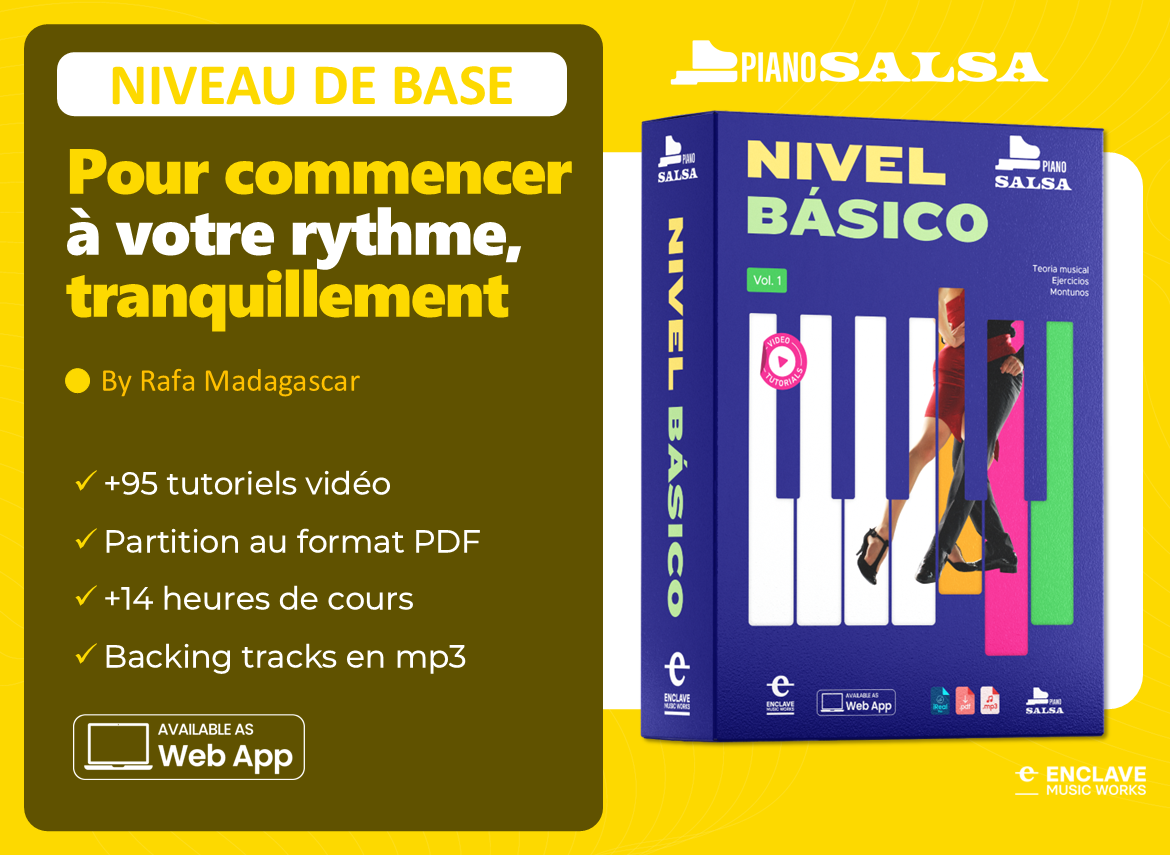
The course NIVEAU DEBUTANT is the first of the collection of the trilogy of the 3 levels of the PIANO SALSA method. This course is organized in 4 large blocks of content: THEORIE, PRATIQUE, MONTUNOS and REPERTOIRE. In each of them, you will find exclusive material to learn and practice. Almost all the videos are accompanied by a downloadable PDF file in which you will find sections or summaries of the content of each lesson.
Once you have purchased the course, you can access it with your user name and password on the website, or with the same user in the Piano Salsa application, which you can find for free on Google Play and Apple Store.
Course subjects :
- In the THÉORIQUE section, you will find explanations on a wide range of subjects, such as harmony, ranges, technical resources applied to salsa, forms and structures, analysis and much more.
- In the PRATIQUE section, you will be able to train your fingers with all kinds of exercises, “play-alongs”, rhythmic independence exercises, exercises to learn chords, harmonic progressions, accompaniments and you can also train yourself with famous montu-nos that will help you to develop fluidity and speed.
- In the MONTUNOS section, you will find videos with didactic explanations where you will learn the construction of montunos, the accompaniments, and you will also see examples with all kinds of rhythms, including “Son Tradicional”, “Son Mon-tuno”, “Guajiras”, “Guarachas”, “Descargas”, “Pachangas”, “Timba” and many others.
- In the REPERTOIRE section, you will find a wide variety of songs classified according to your level. All of them are accompanied by a complete tutorial, as well as a note-by-note transcribed score.
- Students can progress according to their own pace of study, they can study freely or follow a recommended STUDY PLAN, in order to learn with an order and an organized structure.
To whom is this course directed?
This course is aimed at anyone involved in the study of modern piano with a certain knowledge of the piano and anyone motivated to explore the rhythms of Latin music. Any student wishing to approach this field in an effective way will appreciate this course. The basic level will help you to successfully solve and consolidate the first difficult basics that cannot be solved by the student alone, but only with the support of qualified people in this field. Thanks to the video tutorials and demonstrations, you will be able to replay each video tutorial as many times as you wish, and take advantage of all the functions that the reader allows to facilitate learning.
The course NIVEAU DEBUTANT is designed to acquire and consolidate the first basics of Piano Salsa. You will find below a list of the lessons that you will find in this first course, classified in 4 main blocks of content: THEORIE, PRATIQUE, MONTUNOS and REPERTORIO.
NIVEAU DEBUTANT Leçons :
THÉORIE
FUNDAMENTAL ASPECTS TO BEGIN PLAYING SALSA
1.1 The notes of the key on the cover
1.2 The clefs - explanation
1.3 What does it mean to play the Montunos in blocks and arpèges ?
1.4 Forms and structure of a salsa theme.
BASE CHORDS
2.1 Le Ciphras
2.2 Introduction to agreements
2.3 Triads : minor and major agreements
2.4. Triadic agreements: increased, decreased and suspended agreements
2.5. Triads with inversions
2.6 Diatonic triads: agreements in low mode
THE BASIC RANGES
3.1 How can we study the natural wild gametes?
3.2 How to study the natural mineral ranges?
3.3 Harmonic and melodic mine ranges
TONAL PHONATIONS AND HARMONIC PROGRESSIONS :
4.1 Tonal phonings in the soft mode 4.2 Tonal phonings in the soft mode 4.3 Tonal phonings in the soft mode
4.2 Tonal Fonctions in mineur mode
4.3 Introduction to harmonic progressions
PRATIQUE
APPRENDRE A JOUER AU HARPSICHORD
1.1 Learning to play in key 2-3
1.2 Apprendre à jouer en clef 3-2
EXERCICES D'INDÉPENDANCE RYTHMIQUE
1.1 Exercices d'indépendance 1. the keys
2.2 Exercices d'indépendance 2. avec la basse en culbute
2.3 Exercices d'indépendance 3 Avec la coquille
2.4 Exercices d'indépendance 4 Avec la contre-cloche
2.5. Exercice Montuno avec Clave de base
2.6. La basse Danzón : 20 exercices d'indépendance
EXERCISES TO ACQUIRE FLUIDITY AND CONTROL
3.1 Exercise with octaves, to strengthen and secure the octaves.
3.2 Le Tumbao de la basse, main gauche seulement
3.3 Exercice with quadratic harps, 2 voices
3.4 Exercises with harps and chords in block 1
3.5. Basic exercises 1
3.6. Basic exercises 2
3.7. Exercices de formation de base 3
3.8. Exercices de formation de base 4
3.9. Exercices of base 5
PRACTICE OF HARMONIC PROGRESSIONS
4.1 Harmonic progressions (with 2 accords)
4.2 Harmonic progressions 1 (with 3 accords)
4.3 Harmonic progressions 2 (with 3 accords)
4.4 Harmonic progressions 3 (with 3 accords)
4.5. Progressions harmoniques 4 (with 3 accords)
4.6. Progressions harmoniques 5 (with 3 accords)
4.7. Progressions harmoniques 6 (with 3 accords)
4.8. Progressions harmoniques 7 (with 3 accords)
4.9. Progressions harmoniques 8 (with 3 accords)
SUPPLEMENTARY RHYTHMIC EXERCISES
5.1. Exercices Montuno avec Clef (octaves)
5.2 Rhythmic exercises with octaves (explanation)
5.3 Rhythmic exercises with octaves 1 (clef 3-2)
5.4 Rhythmic exercises with octaves 2 (clef 2-3)
5.5. Exercices rythmiques avec les octaves 3 (clef 3-2)
5.6. Exercices rythmiques avec les octaves 4 (clef 2-3)
MONTUNOS
LEARN TO BUILD MOUNTS STARTING FROM ZERO
1.1 Construire un Montuno à partir de zéro 1. Clé 2-3
1.2 Construction d'un Montuno à partir de zéro 1. Clé 3-2
CONSTRUCTION OF MONTUNOS WITH 2 AGREEMENTS
2.1 Construction de Montunos : I V7 majeur et mineur
2.2 Construction de Montunos : I IV majeur et mineur
2.3 Construction des Montunos : II V7 majeur
2.4 Construction de Montunos : I bVII majeur et mineur
EXEMPLES OF SON
3.1 Exemples de son traditionnel : 10 montunos (partie 1)
3.2 Exemples de son traditionnel : 10 montunos (partie 2)
3.3 Examples of traditional offspring: 10 mounts (part 3)
EXEMPLES OF SON MONTUNO
4.1. 12 examples of Son Montuno easy to make !
EXEMPLES AVEC CHACHA
5.1 Basic Chachacha with 10 variations
EXEMPLES OF GUAJIRAS
6.1. Exemple Guajira 1.
6.2. Exemple Guajira 2. rareté in Guajira
6.3. Exemple Guajira 3. Sofrito
6.4. Exemple Guajira 4. El Ratón
6.5. Exemple Guajira 5. saucisse avec œufs
6.6. Exemple de Guajira 6. Guajira Dubois
6.7. Exemple Guajira 7. Bésame Mama
6.8. Exemple Guajira 8. je ne suis plus désolé
6.9. Exemple Guajira 9.
6.10. Exemple Guajira 10. No Tengo pa’ Pagar
6.11. Exemple Guajira 11. Diablo
6.12. Exemple Guajira 12. Lament of a Guajiro
PRATIQUE DES MONTUNOS - Basic level
7.1 Basic Practice 1. We are in Salsa (clave 2-3)
7.2 Basic practice 2 Vámonos pal Monte (key 2-3)
7.3 Base Practice 3 Searching for Guava (key 3-2)
7.4 Basic Practice 4 At Six o'clock (key 2-3)
7.5. Basic Practice 5. Rain with Snow (key 2-3)
7.6. Pratique de base 6. pachanga with guaguancó (clave 2-3)
7.7. Pratique de base 7. Tihuanaco (clef 2-3)
7.8. Basic practice 8. Falling Water (key 2-3)
7.9. Basic practice 9. Quelle humanité (clé 2-3)
7.10. Basic practice 10. Achilipú (clé 2-3)
REPERTOIRE
- CUCALA - Celia Cruz Tutoriel
- I'M NOT FOR YOU - Ismael Rivera Tutoriel
- YOUR FLOWERS AND YOUR HANDKERCHIEF - Ismael Rivera Tutoriel
- RUMBON MELON - Tutoriel Joey Pastrana
- LA PALOMILLA - Joe Cuba Sextet Tutoriel
- CHAN CHAN - Buena Vista Social Club Tutoriel
- RAIN WITH SNOW - Didacticiel Mon Rivera
- CHINESE EYES - Tutoriel Gran Combo
- BRAVA CANE SEED Tutoriel Sierra Maestra
- CACHONDEA - Cheo Feliciano Tutoriel
- HEAR WHAT'S GOING FOR YOU - Eddie Palmieri Tutorial (Part 1)
- HEAR WHAT'S GOING FOR YOU - Eddie Palmieri Tutoriel (Part 2)
- TAKE OFF THE MASK - Ray Barretto Tutoriel (Part 1)
- REMOVE THE MASK - Ray Barretto Tutoriel (Part 2 explanation)
- LADY LAW - Classic Ensemble Tutorial (Part 1)
- LADY LAW - Classic Ensemble Tutorial (Part 2 Explanation)
- MARGIE - Ray Barretto (Tutorial)
- GUAJIRA PA LOS POLLOS - Fania All Stars
- I ALMOST ENVY YOU - Andy Montañez Tutorial