
07 Sep
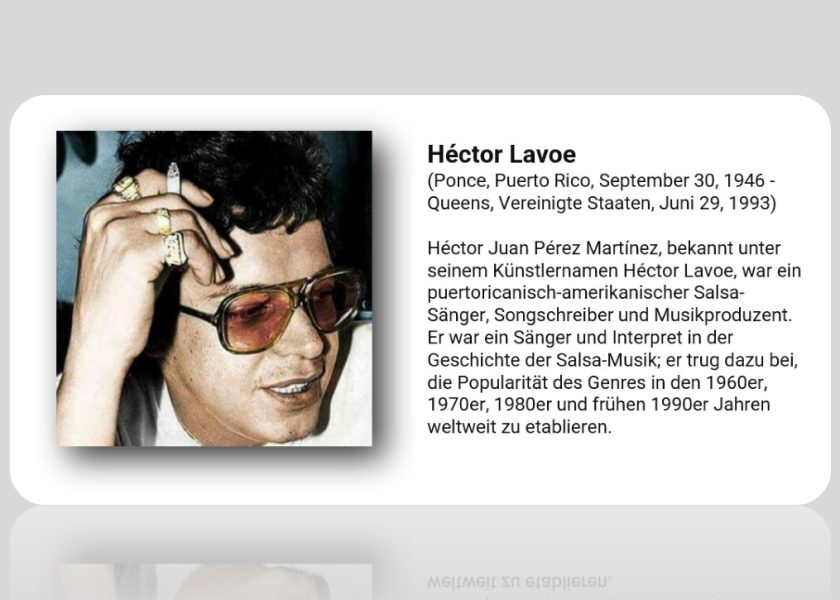
Today we offer you a short biography of Héctor Lavoe and the song “El Cantante”. This great work, which was composed by Rubén Blades and Willie Colón, makes Héctor “Sänger der Sänger”. The text is as if it were another of the life of the Puerto Rican artist.
Über Héctor Lavoe
The singer-songwriter and music producer Héctor Lavoe was born on 30. September 1946 in Puerto Rico in a close-knit family. At the age of three years he lost his mother; he was to be the first of many emotional scenes in the life of his father. His father, who as a guitarist in local trios and orchestras worked with Héctor Musikunterricht. As early as in young years he studied at the Juan Morel Campos School of Music, where he learned to play the piano and saxophone, but he soon realized that the singing was something for him.
Reise nach New York und Anfänge in der Musik (1963-1966)
Héctor träumte davon, in New York zu singen und reiste am 3. Mai 1963 im Alter von 16 Jahren nach New York, wo er mit seiner älteren Schwesteren Priscilla lebte.
Bühne mit Willie Colón und seinem Orchester (1967-1974)
Seit seinen Anfängen in der Musik nahm Héctor Lavoe nahm insgesamt elf Alben mit Willie Colón auf, darunter die beiden letzten Alben The Good, The Bad, And The Ugly (1975) und Vigilante (1983).
By 1988 Lavoe had continued to perform concerts despite his personal problems in order to work on his Grammy-nominated album Strikes Back, which he did not release a few months later.
Merkmale seiner Stimme
A merkmal of Lavoes Stimme was his natural nasality, which he did not show in his voice. A further aspect was the glanz and the reinheit of his voice: he was still not dumping as long as he could. In addition, he had a great deal of power, which gave his interpretations a strong character. Er beherrschte auch sein Stimmregister, das von A2 (wie in einigen Live-Versionen von “La Murga de Panamá” zu hören ist, während er die Posaunenmelodie spielt) bis A4 (wie im Bolero “Tanto como ayer” und “La retirada” zu hören ist) reichte, sehr effizient. Er verfügte über ein gewöhnliches Baritonregister von zwei Oktaven, das von “A2” bis “A4” reichte, mit einer Tessitura, die es ihm leicht machte, seine hohen Töne auszuführen. In addition, he also gives a diction, which he is able to write long, short sentences with great clarity and a good overwrite, which he is able to understand, what he has learned.
„The Singer“ (Der Sänger 1978)
Here we share the song “El Cantante”, a great work that was composed by Rubén Blades and Willie Colón and with which Héctor began to be known as “der Sänger der Sänger”. The text is as if it were another of the lives of the Puerto Rican artists.
Information Quelle: Wikipedia, Geschichte der Salsa.
Thank you for the good writeup. It in fact was a amusement account it. Look advanced to far added agreeable from you! However, how could we communicate?
Hello Ana
you can contact us at info@pianoslasa.com
thank you for your interest in Piano Salsa
musical greetings