07 Sep
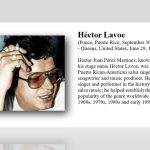
Today, we offer you a brief biography of Héctor Lavoe and the song “El Cantante”. This great work composed by Rubén Blades and Willie Colón allowed Héctor to be known as “the singer of singers”. The songs summarize, like few others, the life of the artist from Puerto Rico.
About Héctor Lavoe
Auteur-composer-songwriter and music producer, Héctor Lavoe was born into a modest family on September 30, 1946 in Porto Rico. At the age of three, he loses his mother; this will be the first of many emotional shocks in the singer's life. His father, who played the guitar with local trios and orchestras, gave music lessons to Héctor, who enrolled very young at the Juan Morel Campos music school, where he studied solfège and saxophone, but soon felt that singing was made for him.
Voyage à New York et débuts dans la musique (1963-1966)
Héctor dreamed of singing in New York, he left for New York where he arrived on May 3, 1963 at the age of 16, where he went to live with his sister Priscilla.
Sur scène avec Willie Colón et son orchestre (1967-1974)
Since his beginnings in music, Héctor Lavoe has recorded eleven albums with Willie Colón, including the last two, The Good, The Bad, And The Ugly (1975) and Vigilante (1983).
In 1988, Lavoe continued to give concerts despite his personal problems, in order to promote his album Strikes Back, nominated for the Grammy Awards, which he didn't return a few months later.
Voice characteristics
One of the characteristics of Lavoe's voice is his natural nasality, which he does not simulate when he sings. Another aspect is the luminosity of his voice and its propensity: it is neither raspy nor soft. In addition, he possessed a great singing strength, which gave a strong character to his interpretations. He also had a very effective management of his vocal range, which went from A2 (as we can hear him in some live versions of “La Murga de Panamá”, playing the trombone melody), to A4 (as we can hear him in the bolero “Tanto como ayer” and “La retirada”). It had a common two-octave baryton register, ranging from “A2” to “A4”, with a key that allowed him to easily express his high notes. It also had a diction that allowed him to sing long and fast phrases with a great clarity and a good emission, which allowed the listener to understand what he was singing.
The Singer (1978)
We share here the song “El Cantante”. Great work composed by Rubén Blades and Willie Colón, it is thanks to this song that Héctor began to be known as “the singer of singers”. The songs summarize the life of the Puerto Rican artist like few others.
Source d'information : Wikipedia, History of Salsa.